
Skopje marks Friday the 50. anniversary from the 1963 catastrophic earthquake, in which 1,070 people lost their lives, while 3,000 were injured.
Numerous delegations and citizens laid flowers at the monument of the perished in the earthquake at the Skopje city cemetery, including Parliament Speaker Trajko Veljanoski, Skopje Mayor Koce Trajanovski, PM's Cabinet representatives, political parties, city's municipalities, Red Cross, Macedonian Army, as well as foreign delegations, UNICEF etc.
Numerous delegations and citizens laid flowers at the monument of the perished in the earthquake at the Skopje city cemetery, including Parliament Speaker Trajko Veljanoski, Skopje Mayor Koce Trajanovski, PM's Cabinet representatives, political parties, city's municipalities, Red Cross, Macedonian Army, as well as foreign delegations, UNICEF etc.
The Red Cross of the City of Skopje organized the traditional humanitarian blood donation campaign, whereas a religious service was held in church "St.Kliment Ohridski".
This evening's official programme includes poetry reading "To Skopje with Love" in front of the Museum of the City of Skopje, while exhibition titled "26 July 1963" will open in museum's premises.
Multimedia project "Skopje Remembers" will be held at Macedonia Square, whereas the Macedonian Cultural Centre will screen a 24-hour film marathon, along with exhibition "Show Your Hope".
This evening's official programme includes poetry reading "To Skopje with Love" in front of the Museum of the City of Skopje, while exhibition titled "26 July 1963" will open in museum's premises.
Multimedia project "Skopje Remembers" will be held at Macedonia Square, whereas the Macedonian Cultural Centre will screen a 24-hour film marathon, along with exhibition "Show Your Hope".
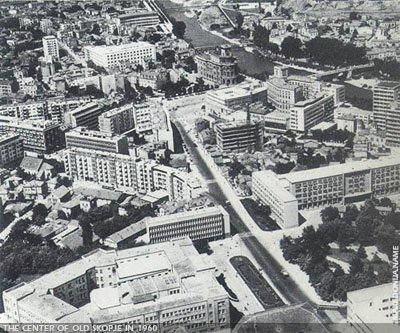
A broken clock marking the time of the earthquake, 5:17 a.m., remains at the scene. The severe earthquake left some 80 percent of Skopje in ruins, with 1.070 dead persons and more than 200.000 homeless.
Relief in money and kind, including medical, engineering, and building teams with supplies, came from 78 countries. From this, Skopje was called the 'City of International Solidarity.'
In the days after the earthquake, 35 nations asked the United Nations General Assembly to put relief for Skopje on its agenda, and a campaign directed at national governments and international agencies began to identify resources to assist in recovery efforts. As the General Assembly stated in resolution 1882 of 14 October 1963, the spirit of international solidarity demonstrated in the aftermath of the Skopje earthquake transformed the reconstruction effort into a symbol of friendship and brotherhood among peoples.
In the days after the earthquake, 35 nations asked the United Nations General Assembly to put relief for Skopje on its agenda, and a campaign directed at national governments and international agencies began to identify resources to assist in recovery efforts. As the General Assembly stated in resolution 1882 of 14 October 1963, the spirit of international solidarity demonstrated in the aftermath of the Skopje earthquake transformed the reconstruction effort into a symbol of friendship and brotherhood among peoples.
Prior to 1900, the seismic history of Skopje, as part of the Vardar seismic zone, is practically reduced to a rather brief description of the earthquake catastrophes of Scupi in 518 A.D. and that of Skopje in 1555. The old Scupi was situated about 4-5 km northwest of the center of the present Skopje. As ground fissure extending over 45 km in length and up to 4 meters in width is reported for this earthquake, it seems that it is the strongest shock that has ever occurred in Macedonia. The earthquake of 1555 is said to have demolished a part of Skopje. Both earthquakes are estimated to be of strong intensity.

